
Scientific Approaches to the culture of "Washoku"– Umami Lecture at Tohoku University
December 2025
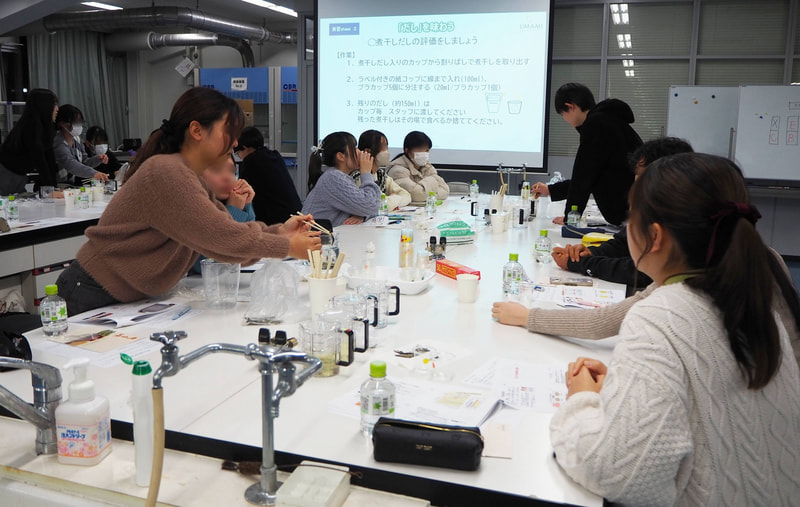
On December 25, 2025, the Umami Information Center (UIC) delivered a special lecture for freshmen at Tohoku University.
This session was held as part of the " Introductory Seminar: Scientific Approaches to the culture of ‘Washoku’," an official course at the university. The seminar is led by Professor Nobuyuki Sakai—a professor at the Faculty of Arts and Letters and Vice-Chairman of UIC—and involves collaboration with various corporations and external organizations. Since 2016, UIC has been in charge of this annual lecture, aiming to help students "experience the deliciousness of dashi and umami, and learn how to communicate its value" through theory, tastings, and practical training. For many students who rarely have the opportunity to make dashi from scratch, this hands-on learning experience is a valuable highlight of the curriculum that they truly look forward to.
The session was attended by 25 students from six different faculties, including Medicine, Agriculture, and Education. The lecture was delivered by UIC Director Yasue Kido, with demonstrations performed by UIC’s Hiroko Kadota.
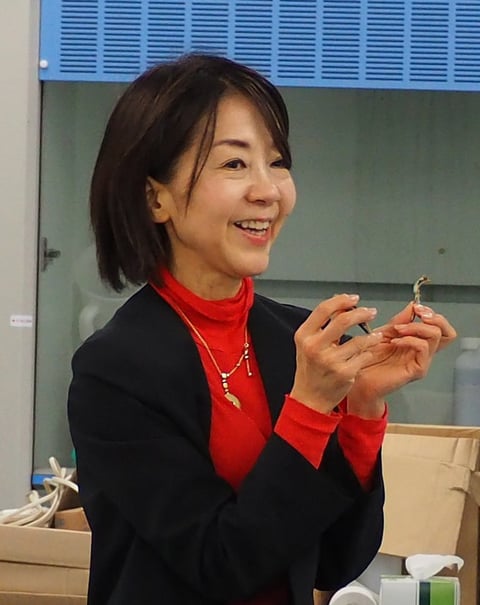
The lecture began with fundamental concepts such as the "relationship between deliciousness and umami" and "umami substances found in various foods." Using actual samples, UIC Director Kido introduced representative dashi ingredients: kombu (dried kelp), katsuobushi (dried bonito), hoshi-shiitake (dried shiitake mushrooms), and niboshi (dried sardines).
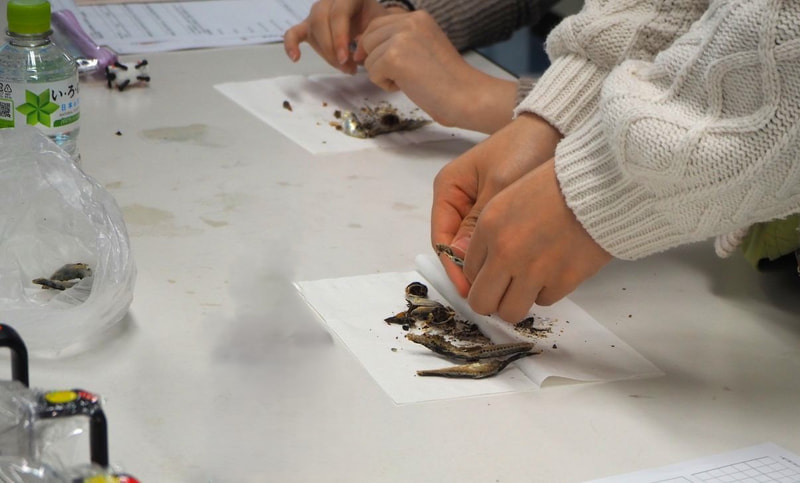
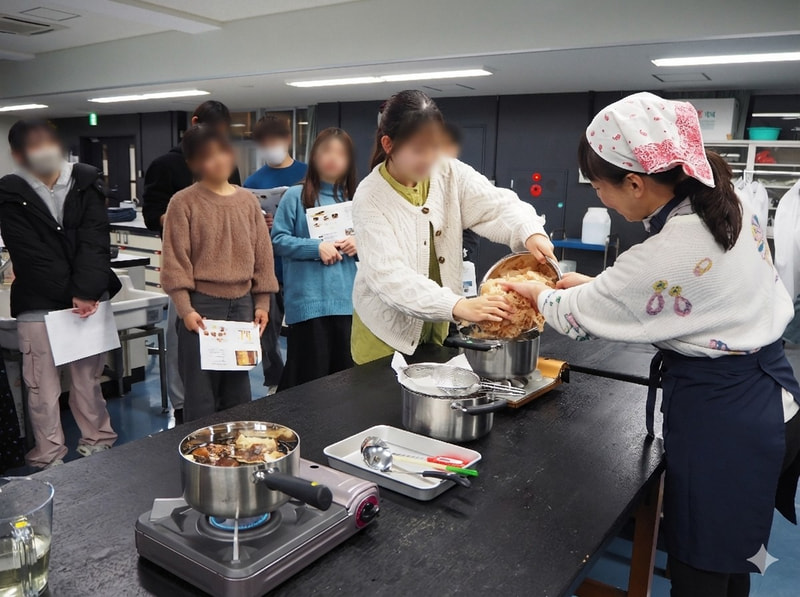
During the hands-on session for preparing niboshi, some students initially struggled with removing the heads and entrails, with some noting, "It’s crumbling into pieces!" However, once they grasped the technique, they were able to proceed smoothly. During the dashi-making demonstration, students observed the different brewing dashi methods required for each ingredient—each backed by scientific evidence—while taking in the rich, savory aromas.
The "experience" segment kicked off with a tasting of sun-dried tomatoes, which are rich in glutamate. Students were instructed to chew slowly (20 to 30 times) to fully isolate the taste of umami. Through this, they identified the three key characteristics of umami: persistence (aftertaste), spreading across the entire tongue, and the promotion of salivation.
Next was the dashi tasting. After sampling single-ingredient dashi made from kombu, katsuobushi, and hoshi-shiitake, the students tasted "blended dashi" (Kombu dashi x Katsuo dashi and Kombu dashi x Hoshi-shiitake dashi). The room was filled with surprised voices as they experienced the "Umami Synergetic Effect." By combining glutamate (from kombu) with inosinate (from katsuobushi) or guanylate (from hoshi-shiitake), the umami intensity increases significantly compared to single-ingredient dashi.
Furthermore, students tasted seven variations starting with a base of "miso-yu" (miso dissolved in plain hot water), followed by versions where different single or blended dashi were added to compare the flavors. Fifteen out of twenty-five students chose the "Kombu dashi x Katsuo dashi" blend. Their analysis was remarkably insightful, with comments such as, "It is mellower than single-ingredient versions, providing a better balance in miso soup," and "It is likely because the blend provides a rich depth of flavor and taste without being too intense."
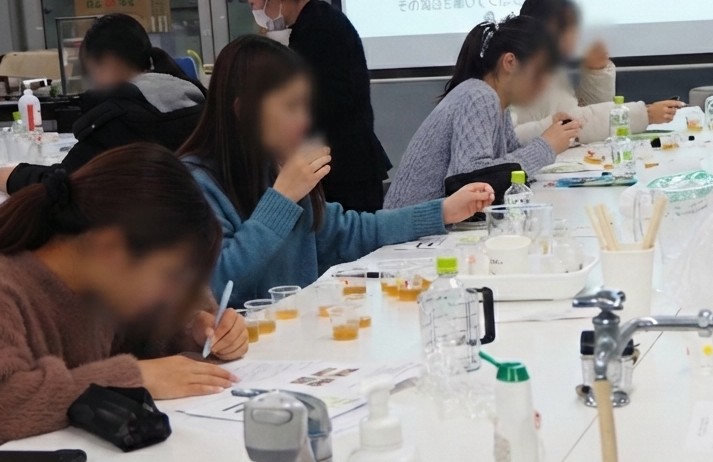
In an experiment using lightly salt-pickled cucumbers, students compared a standard version to a version with 30% less salt and added MSG (monosodium glutamate). They remarked that this version (with added MSG) "tasted mellower" and was "delicious even with less salt." This allowed them to experience firsthand how umami substances can mitigate the bitterness of vegetables and maintain palatability even with less salt.
To conclude, students filled out worksheets reflecting on each experiment and summarized what they most wanted to share with others.
■Student Insights: Characteristics of Dashi and Umami, Umami substances (Excerpts)
- Compared to overseas stocks, Japanese dashi specializes in the extraction of umami substances, resulting in an umami-focused finish that is pure and free of any impurities.
- The fact that dashi contains only a "select few" types of amino acids might reflect a Japanese cultural aesthetic of eliminating waste and focusing on the essence.
- My parents and grandparents struggle with high blood pressure, and exercise hasn't shown results. I felt that using dashi and umami substances could help by adding depth to low-salt meals and potentially improving their condition.
- Umami enhances flavor and taste allows for salt reduction while maintaining deliciousness. And beyond mere good taste, it is highly anticipated as a taste that supports healthy eating habits.
- While often unnoticed in daily meals, umami is essential for making meals taste better—just as dashi transforms the taste of miso soup.
- I particularly want to share the benefits of katsuo dashi and how to make it. Compared to hoshi-shiitake mushrooms or kombu, it is affordable and the extraction time is remarkably short, so I felt that even those living alone can easily enjoy dashi.
■Most Meaningful Takeaways (Excerpts)
- Learning about the temperatures and timing of dashi extraction from a scientific perspective.
- Being able to learn how to make dashi by watching the live demonstration.
- Gaining a clear understanding of the distinction between "Umami" as a scientific basic taste and "Umami" as a general Japanese term for deliciousness.
- By experiencing umami through tasting sun-dried tomatoes, I think I can now recognize it whenever I eat foods containing umami substances.
- I was genuinely surprised by the Umami Synergetic Effect. I never imagined that umami could become so intense and delicious.
The sight of students collaborating on experiments and discovering the profound value of umami was truly impressive. The diverse words they shared about dashi and umami through their individual sensibilities will provide great inspiration for UIC’s future communication efforts.
We hope they will carry forward the wonders of umami noticed today, applying this insight to their own paths and sharing it with those around them.