
Umami Lecture for Graduate Students of Otsuma Women’s University
December 2025
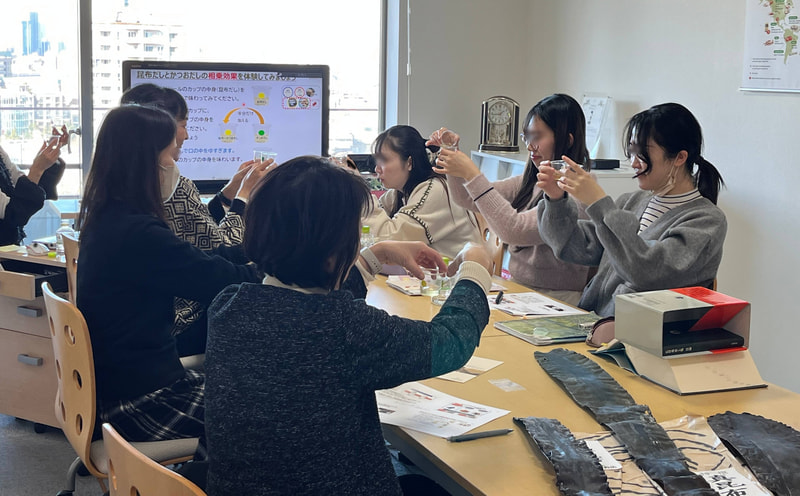
On December 26, 2025, five students from the Graduate School of Otsuma Women’s University visited the Umami Information Center (UIC) together with Professor Miho Otahara. The graduate school actively incorporates taste education and, based on the “Taste Lessons” systematized by the French Jacques Puisais, has been cultivating to date the ability to sharpen the five senses, savor food attentively, and express perceptions in words through an educational approach (the Puisais theory) that emphasizes the verbalization of sensory experience.
On this occasion, as part of the intensive course “Special Topics in Culinary Science,” we held a special lecture on the theme of “umami” to help them deepen their understanding.

Understanding Umami through Science and Hands-on Experience
In the lecture, we introduced the scientific foundations of umami—its three main characteristics of “spreading across the tongue,” “lingering,” and “stimulating salivation”—together with tastings designed to make participants aware of these features. We also explained health-related benefits such as applications to salt reduction. The session was structured to connect scientific knowledge with practical experience so that participants could deepen their understanding.
The participants came from diverse backgrounds, including students who advanced directly from the undergraduate program to graduate studies, a participant with experience as a nutrition teacher, and another who teaches at a junior college.
Their sharp sensory awareness and articulate expressions appeared throughout the session, which remained lively from start to finish.
Sensing umami with dried tomato
In the first exercise, participants chewed a piece of dried tomato 20–30 times, focusing on how the taste evolved. One striking comment was, “At first the sourness was strong, but it diminished as I chewed, and after swallowing I felt as if my tongue had been gently coated.” It was a moment in which they directly experienced that umami lasts longer than sourness or sweetness.
Experiencing umami synergy with kombu dashi and katsuobushi dashi
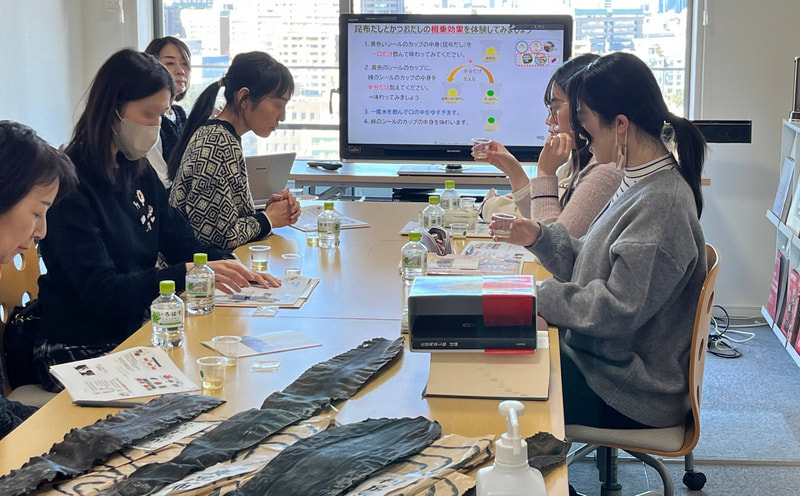
Next, participants explored umami synergy using kombu dashi (broth) and katsuobushi dashi (broth). They first tasted kombu dashi, then added katsuobushi to create awase dashi (a combined dashi).
Comments included: “When combined, the taste gained depth and the aroma stood out—it was moving,” and “The umami intensified, and I felt an increase in saliva.”
Combining amino-acid-based glutamate (from kombu) with nucleotide-based inosinate (from katsuobushi) can make umami perceived up to seven to eight times stronger than either alone. Participants also seemed to sense first-hand umami’s ability to promote salivation.
Exploring the Functional Properties of Umami Substances Using MSG
In the next exercise, we examined the effect of an umami substance by adding 0.1% monosodium glutamate (MSG) to a lightly seasoned vegetable bouillon. MSG is monosodium glutamate, an umami substance found in dashi (broth) and in many foods, and it contributes to the deliciousness of dishes.
Perceptive comments followed one after another: “Although the aroma at the nose (orthonasal) did not change, the sample with MSG had stronger aroma in the mouth (retronasal) and stronger taste the moment it entered,” “It felt as though MSG was bringing out the vegetable notes,” and “The saltiness became milder, and the sharp aftertaste of onion softened.”
Participants thus recognized that umami substances can both intensify taste and round out the overall profile.
Finding their own “appropriate amount
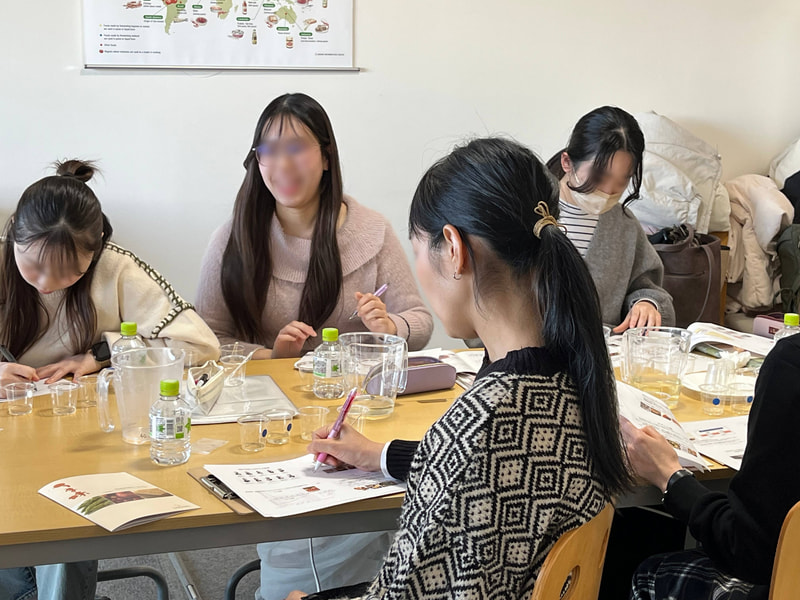
In culinary practice, umami seasoning allows one to conveniently make use of umami substances; like salt or sugar, however, it has an “appropriate amount,” which varies by individual preference. Each participant adjusted the addition level of MSG step by step to find the amount that felt most pleasant to them.
They perceived how taste changes with the amount added and understood that, by tuning it to suit the purpose and their preferences, they can move closer to the desired deliciousness.

Viewing Umami from Nutrition and Health Perspectives
In the latter part of the lecture, we introduced applications in the fields of nutrition and health, such as how umami can support salt reduction and examples of improving taste disorders by taking advantage of umami’s salivation promoting property. For participants who wish to focus their future work on nutrition and health, it proved to be a practical learning experience.
■Voices of Participants (Selected & Edited)
- Although umami is delicate, I realized that it is an essential taste that supports cooking. I felt that it is up to us, who have learned about it, to help spread this understanding.
- I knew about umami in theory, but experiencing it firsthand allowed me to truly understand it.
- Eating is a lifelong activity. By making use of umami, I hope that older adults can continue to enjoy their meals and genuinely feel, ‘Ah, this is delicious.’
- I felt that what I learned this time can be applied to daily eating habits, as well as to recipe development and food education.
■Materials introduced in the lecture
Umami Information by Food | Umami Information Center
Umami Database | Umami Information Center
YouTube Umami basics
We sincerely hope that the participants will carry this learning forward and share the appeal of umami widely in their future endeavors.