Umami, Kokumi, and Koku: Unlocking the Deliciousness of Dry-Cured Ham
April 2026
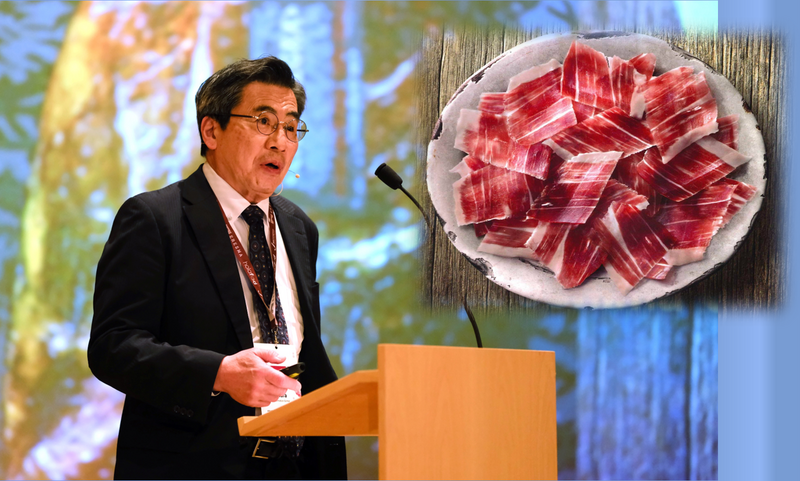
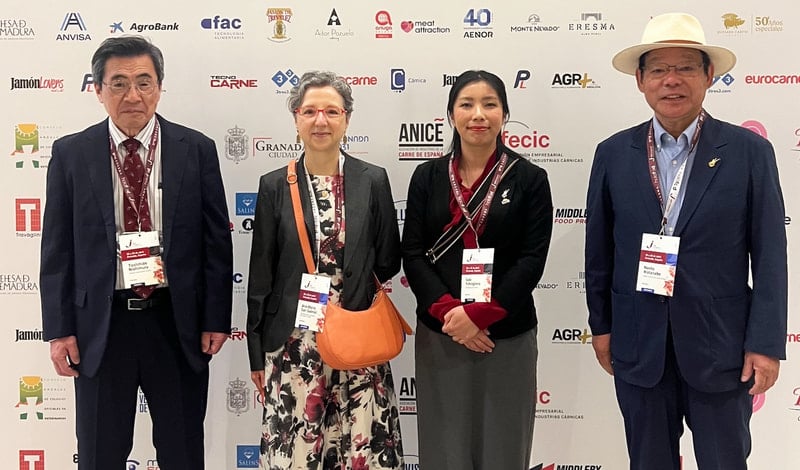
At the XIII World Ham Congress held in Granada, Spain, the Umami Information Center (UIC) contributed to advancing the science behind one of the world’s most cherished foods: dry-cured ham. Among leading experts discussing innovation, sustainability, sensory science, and quality, the UIC Chairman Dr. Toshihide Nishimura delivered a highly anticipated presentation that resonated with chefs, food lovers, and nutrition professionals alike.
His talk addressed a deceptively simple question: What makes dry-cured ham so delicious? The answer, he proposed, lies in a deeper understanding of three often-confused concepts—umami, kokumi, and Koku—and how they interact to create the rich and satisfying experience we enjoy.
Beyond Taste: A New Way to Understand Deliciousness
Deliciousness is more than taste alone. As Dr. Nishimura explained, when we eat, our perception of flavor is shaped by the integration of taste, aroma, and texture. These elements interact dynamically in what scientists call the “crossmodal congruency effect,” ultimately determining how we perceive a food.
To describe this integrated experience, Dr. Nishimura introduced the concept of Koku—a holistic sensory impression characterized by complexity, mouthfulness, and lingeringness. Importantly, Koku is not a taste, nor a specific substance, but an emergent property of how all sensory inputs come together.
Clarifying Umami, Kokumi, and Koku
A central message of the presentation was to clearly distinguish three key concepts:
- Umami is one of the five basic tastes, primarily driven by glutamate and certain nucleotides and peptides. In dry-cured ham, long ripening leads to the accumulation of free amino acids, especially glutamate, which provides a subtle savory taste and enhances overall flavor.
- Kokumi substances are compounds—such as γ-glutamyl peptides—that enhance sensations like mouthfulness and continuity of basic tastes by addition of their subthreshold levels. These compounds develop naturally during the maturation process of ham.
- Koku, in contrast, is the overall sensory experience: the complexity, mouthfulness, and lingeringness that make a food truly satisfying. It emerges from the interaction of taste, aroma, texture, and time-related changes during eating.
By separating these concepts, Dr. Nishimura provided a clearer framework to explain why dry-cured ham is perceived as exceptionally rich and appealing.
Key message:
Deliciousness is not a single element, but the integration of multiple sensory factors. Understanding umami, Kokumi substances, and Koku enables better flavor design, communication, and appreciation.
Survey on Understanding and Usefulness of Umami, Kokumi Substances, and Koku Concepts
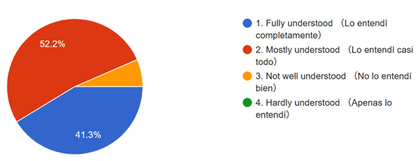
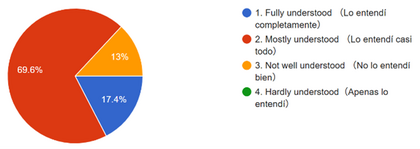
A short survey conducted after the lecture on umami, Kokumi substances, and the concept of Koku (n=46) indicated a generally high level of participant understanding and perceived usefulness.
Regarding the Koku concept(Q1), 41.3% of respondents reported full understanding and 52.2% reported mostly understanding, with only a small proportion indicating limited comprehension.
Similarly, 87.0% of participants (17.4% fully and 69.6% mostly) understood the differences between umami, Kokumi substances, and Koku(Q2).
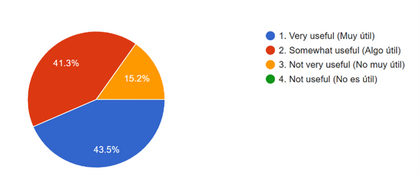
In terms of usefulness(Q3), 84.8% found the lecture content useful (43.5% very useful and 41.3% somewhat useful) for areas such as education, product development, and quality evaluation, suggesting strong relevance of the topic despite some remaining gaps in deeper conceptual clarity.
Dry-Cured Ham: A Model of Flavor Complexity
Dry-cured ham serves as a perfect example of how Koku is created. During its long ripening process, multiple biochemical reactions occur:
- Proteolysis generates amino acids and peptides contributing to umami taste and the enhancement of flavor
- Lipolysis and oxidation produce volatile compounds responsible for characteristic aromas
- Texture changes, including fat melting, influence mouthfeel and flavor release
These elements interact over time, creating a layered and evolving sensory experience. The result is a product with remarkable complexity—where each bite delivers not only flavor but also persistence and satisfaction.
************************************
Tasting Experience: From Aging to Umami: Exploring Flavor Intensity and Continuity in Cured Ham
This tasting experience was held on the day before the presentation on April 29th. UIC Chairman Dr. Toshihide Nishimura with the support of UIC board member Ana San Gabriel conducted an interactive tasting session with over 85 participants to explore flavor perception in cured ham. Two samples were presented: Sample A (14-month aged) and Sample B (18-month aged).
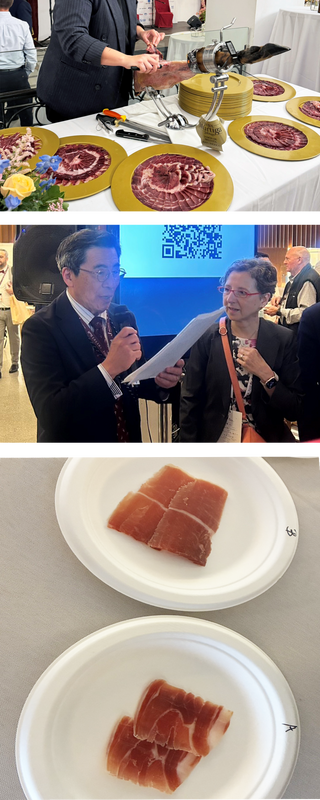
Participants first evaluated the samples without seasoning.
A majority (68.2%) perceived Sample B as having the stronger flavor compared to 31.8% for Sample A, and 83.5% identified Sample B as having a longer aftertaste versus 16.5% for Sample A, indicating a clear preference for the more aged ham in both intensity and persistence.
Participants were then instructed to sprinkle umami substances onto the sample perceived as weaker. Following this step, 89.4% reported that the flavor became stronger, while only 10.6% perceived no change.
Overall, the results demonstrated that extended aging enhances both flavor intensity and aftertaste in cured ham, and that the addition of umami substances effectively amplifies perceived flavor, even in samples initially judged as milder.
The UIC would like to express its sincere gratitude to the Japan Cured Ham Association for its generous support, without which this event would not have been possible. Special thanks are also extended to Mr. Naoto Watanabe and Ms. Saki Yokokawa for their contributions.