
Umami Lecture at Kichijoji Futaba Nutrition Cooking Professional School
July 2026
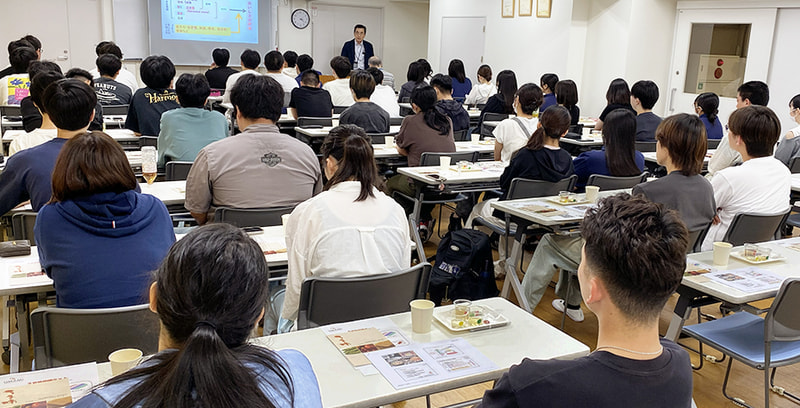
Students at culinary schools hone their skills day after day in pursuit of that “professional taste” that moves people. How do professional chefs and cooks understand the mechanisms behind deliciousness in their work?
The Umami Information Center (UIC) held a special lecture, “The Role of Umami Substances and Umami Ingredients in Enhancing Deliciousness,” at Kichijoji Futaba Nutrition Cooking Professional School* on July 15, 2026. Fifty students aspiring to become professional chefs and culinary professionals took part in the session, where they learned about the relationship between umami and deliciousness.
*Kichijoji Futaba Nutrition Cooking Professional School is a vocational college that trains future chefs, registered dietitians, and nutritionists. Its distinctive curriculum is designed to cultivate highly practical culinary professionals, as well as registered dietitians and nutritionists who possess strong cooking skills and hands-on culinary experience.
The school offers two academic tracks: one focused on training registered dietitians and nutritionists, and the other on culinary arts. Dr. Toshihide Nishimura, Chairman of UIC, regularly teaches Introduction to Food Science, a core course in the nutrition program. Building on this collaboration, UIC was pleased to offer its first special lecture on the science behind umami for students pursuing culinary training.
The session began with an opening remark by Manabu Ohno, Head of the Culinary Arts Department: “Now, Umami is the common language of the culinary profession.”
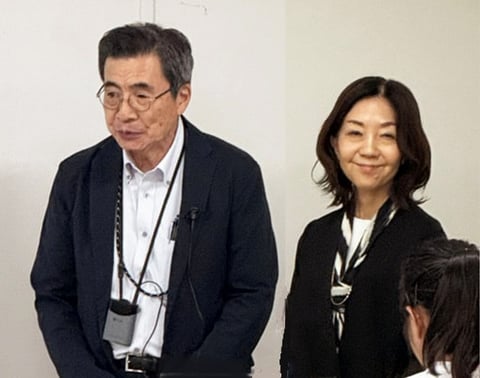
The main lecture was presented by Dr. Toshihide Nishimura and Yasue Kido, Director of UIC.
In the first half of the lecture, Dr. Nishimura explained the factors that determine the palatability of food and discussed how umami substances contribute to our perception of deliciousness. When we say, “This food is delicious!”, our judgment is based on much more than taste alone.
A wide range of factors shape our perception of deliciousness, including appearance, aroma, the sounds we hear while eating, texture, and temperature, as well as who we share the meal with and the environment in which we eat it.
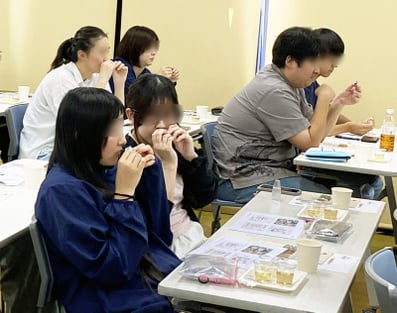
Through a candy-tasting, Dr. Nishimura guided students through the sensory mechanisms behind taste and aroma, highlighting the differences between these two perceptions and explaining how they work together to create flavor. He also introduced the concept of the five basic tastes and their importance in our experience of deliciousness. Umami is one of these five basic tastes and was first identified by Japanese scientists.
Dr. Nishimura then turned to umami, a term that has become part of the global culinary vocabulary. Explaining its discovery and characteristics, he guided students through tastings of dried tomatoes – rich in umami compounds –, kombu dashi, katsuo dashi, and vegetable bouillon. The students approached each sample with keen attention, thoughtfully tasting and comparing the different broths as they refined their sensory awareness.
The umami rich ingredients can intensify umami of a dish and add Koku to it. It would even contribute to salt reduction. Guided by Dr. Nishimura, the students participated in a series of tasting exercises designed to illustrate sensory concepts such as the synergistic effect of umami.
As they experienced these effects for themselves, their faces reflected both surprise and understanding.
The second half of the lecture was led by Yasue Kido, who explored how professional chefs around the world make practical use of umami-rich ingredients in their cooking. Showing visual examples of stocks and boths from diverse culinary traditions, she explained that the umami synergy effects have long been utilized in cuisines across the world, regardless of cultural or geographic boundaries.
Kido also introduced the “umami stock” prepared exclusively with Western ingredients, including chicken, cured ham, and dried tomatoes, without the use of kombu or katsuobushi. As she emphasized that “cooking with umami-rich ingredients is not something unique to Japanese cuisine,” many students were seen nodding in agreement.
The lecture concluded with a selection of comments from some of the world's leading chefs, who shared their enthusiasm for the power and potential of umami ingredients. Their passion for their craft clearly struck a chord with the audience, leaving many students both inspired and motivated in their own culinary journeys.
The post-lecture survey generated many positive comments from the students:
• “I was glad to learn much about umami substances.”
• “I had always used the term Koku rather vaguely, but this lecture helped me
understand what it really means.”
• “The hands-on tasting activities made it easier to deepen my understanding.”
Culinary professionals are dedicated to pursuing deliciousness. By understanding the science behind deliciousness and making the most of umami ingredients, we hope you will create truly memorable dishes. We look forward to your future success.